[sticky entry] Sticky: Intro (July 2026)

Jan. 1st, 2000 12:00 am
lucymonster: (Default)
Hi! I'm Lucy. Australian, 30s, she/her, [archiveofourown.org profile] lucymonster on ao3.

Topics on this blog include fandom (mostly Star Wars), music (mostly metal), and whatever I happen to be reading/watching/playing. Right now I'm heavily into horror but you will also see lots of SFF, smatterings of other genre fiction, a bunch of nonfiction, and now and then some Christian theology.

Media and fandom talk are public; RL natter usually goes under f-lock. Let me know if you're interested in being added to my filters for parenting and/or church talk. (I do not promise my non-filtered posts will be free of these topics, but I try to keep the really heavily focused stuff opt-in.)

Feel free to add me for any reason! Introduce yourself here if you like - I'd love to hear from you - but no pressure if you'd rather lurk or just slide straight into the comments of any of my posts and start chatting like we're old friends.
lucymonster: (horrorsinhouse)
Forbidden Fruits 2026: Comedy horror, heavily stylised movie about four young fashion retail workers whose leader, Apple, has them ensnared in a secretive, controlling witches' coven. It was definitely saying something about toxic female friendships, but what exactly that something was, I'm not sure I could tell you. It was very pretty, very vibes-based and not particularly coherent. (Admittedly, I watched it drunk.)

I enjoyed myself anyway, especially because Lili Reinhart is absolutely amazing as Apple. But I was hoping for something more, idk, The Craft meets Mean Girls, which I think is actually what the movie was trying to be, and in the end it just didn't quite get there.

Bodies Bodies Bodies (2022): Also comedy horror. A group of rich, dumb, very dramatic Gen Z friends lock themselves away in a remote mansion for a hurricane party; they are playing what's supposed to be an innocent game of murder in the dark when bodies start turning up for real. This is Glass Onion for morons, in the absolute BEST possible way. I have a lot of affection for Amandla Stenberg from her twin roles in The Acolyte, but she is one of those actors who gives off very strong "knows about TikTok" vibes even when she's running around with a lightsaber, so it was nice to see her sink her teeth into a role where knowing about TikTok was part of the point. She really shone as the troubled, newly sober lesbian protagonist/final girl whose relationships with the group were falling apart even before people started dropping dead.

Us (2019): All horror, no comedy by Jordan Peele starring Lupita Nyong'o. The Wilson family are enjoying a coastal holiday when a family of doppelgängers show up in their driveway hellbent on killing the people whose existence has unwittingly been keeping them enslaved. The doppelgängers, called the Tethered, come from a mysterious underworld and share a soul with their above-world doubles; everything their double does, each of them is forced to perform a twisted simulacrum of, all while trapped in a miserable prison-like space and wearing orange jumpsuits.

I went into this one with extensive spoilers because of the kid characters, and yet I somehow managed not to spoil myself for the final twist, which I'm...not sure if I like or not? I really enjoyed the shock of the reveal, but the longer I've dwelt on it, the more I feel it not just subverts but actually contradicts some of what the movie told us previously. With or without the ending, though, it was a fantastic film and Lupita Nyong'o was breathtakingly good as Adelaide and Red.

Bonus DNF is a thriller, not a horror movie, but I also recently attempted Gravity (2013) - about the sole survivor of an ill-fated mission on the Hubble Space Telescope - and got about halfway through before the stress became too much. Even Sandra Bullock putting in an absolutely amazing performance as a scientist and first time astronaut was not enough to make the sheer cortisol overload worth it for me (and admittedly, my ability to invest in her was hampered by having to fast-forward through her backstory because child death). I love space exploration! I have enjoyed other survival thrillers! But the pacing of this one was just utterly relentless, and the dangers excruciatingly drawn-out, and in the end I couldn't do it.
lucymonster: (watchingthroughfingers)
I have broken free of my horror movie slump with two really wonderful, nuanced films about troubled women being tormented by personified manifestations of our collective cultural anxieties. And also a haunted asylum adventure that was only okay and doesn't really belong in the same post as these masterpieces, but my list of things I want to post about (or more accurately, to HAVE posted about) is so drastically outstripping my willingness to actually sit down and post at the moment that I can't afford to be choosy.

Smile 2 (2024): Hat tip to [personal profile] snickfic for advising me to give this sequel a chance after being fairly underwhelmed by the first one. Smile 2 takes the concept - supernatural entity with a creepy smile latches onto its victim, torments them for a few days, then transmits itself to the next victim by forcing the current one to commit gory suicide in front of them - in a much more interesting direction through its protagonist Skye Riley (Naomi Scott), a pop star trying to make a comeback after an extremely messy public breakdown resulting in a drug-fueled car crash that killed her celebrity boyfriend. Scott brings so much complexity and realistic psychological anguish to Skye's miserable gilded cage life, and the film is deeply interested in complicity: Skye's, as she continues to stake her life on fame and success even as they crush her; her mother, whose standing on the selfless-supporter-to-nightmare-stage-parent spectrum is never entirely resolved; the in-universe public, reducing Skye's painful human struggles to a source of entertainment; us, the real viewers, who can all easily name at least half a dozen real female celebrities we have personally watched get flushed down the same toilet. Being chased by a demonic smiling entity that no one but you can see, that fucks with your grip on reality and isolates you from every possible source of support, feels like such a tailor-made metaphor for life as a beautiful young woman under intense public scrutiny that it's honestly kind of bizarre this is a sequel instead of the original idea for which the Smile universe was made.

Saccharine (2026): Med student Hana is trapped in a spiral of disordered eating when she learns of an obscure new weight loss pill called "grey" that causes the kilos to fall off no matter how much you eat. Unable to afford the branded pills, Hana analyses one in the university lab to discover it's made of human ash, then steals from a donated cadaver to manufacture her own. But as her weight loss dreams start to magically come true, she is haunted by menacing visions of the morbidly obese donor whose body she has been consuming in five gram increments.

Fatphobia is obviously a complicated topic with no one-size-fits-all (no pun intended) answer. I don't know how this film would feel to watch as a "true" fat person, and while stridently critical of diet culture, it is not exactly aligned with the body positivity movement. It seems to me (maybe due to personal bias) laser-targeted towards women who wear standard sizes and can shop in mainstream clothing stores but feel painfully aware of the extra padding they carry compared to the beauty standard. Women for whom thinness is only barely, tantalisingly, out of reach, whose ideal weights would be only a few short months away if they could just somehow manage to shed a perfectly healthy one kilo per week, but whose cravings and binges and obsessive love-hate relationship with food keeps tugging them off track and into pits of counterproductive self-loathing. All the long, unflinching close-up shots of Hannah eating - the way they always teetered on this knife's edge of hedonistic bliss and despairing revulsion - were emotionally shattering and almost unbearably relatable as a viewer with her own history of food-related fuckedupness. I loved, too, the exploration of how Hana's body image issues poisoned her sexuality as a same sex attracted woman, making it almost impossible for her to distinguish between women she was attracted to and women she wished she could be. And - again, I think this is a device more sensitive to viewers on the small side of overweight than the larger - but I really loved and appreciated how Hana's twisted need to dehumanise those much fatter than her was drawn to the surface: the cadaver is simultaneously an object of revulsion and a product she literally consumes for her own ends, and it's a painful, long-overdue slap in the face when the monstrous corpse she and her classmates have insultingly nicknamed "Big Bertha" is finally shown as a real human being with a complex life story and people who loved her and still cherish her memory.

The ending was not what I yearned for, but damn, the story earnt it.

Grave Encounters (2011): Eh. This was fine. It's another found footage horror, tracking a crew of paranormal investigators who go to film an episode of their TV show in an old asylum and run into rather more paranormal activity than they bargained for. Mostly I was amused by the dated MTV-core of it, and how accurately they captured the essence of wildly overacted 2000s-era American reality shows. It was mildly entertaining but not one I'm ever going to feel the need to rewatch, I don't think.
lucymonster: (skeleton)
I've been on a bit of a musical nostalgia kick ([personal profile] rhoda_rants I still need to reply to you about this, you are not forgotten or unwanted I'm just a disaster) revisiting the bands I loved in high school to see how many, if any, I can still appreciate today. My main rule is that I have to be willing to play a whole album all the way through; shitty bands that happened to produce one or two bangers do not count. I've been working my way through my old collection from (loosely) least to most promising, and so far I can report that Behind Crimson Eyes, Pierce the Veil, Aiden, Hawthorne Heights and Hidden in Plain View are all borderline fucking unlistenable, as is Senses Fail's debut album, Let It Enfold You.

Still Searching, though - damn, guys, this is some actually pretty good emo music! It takes the genre's depressive, confessional leanings to the extreme, being basically a concept album about a lightly fictionalised avatar of the lead singer going through a severe mental health crisis. It is angry, angsty, shamelessly self-absorbed, and so honest it almost feels like a privacy violation to listen to. Gets right down into the nitty-gritty of what it's like to have a breakdown. And yes, it is whiny as fuck, but what do you expect? If it's not whiny you're not legally allowed to call it emo, it's just sparkling introspective rock at that point.

My favourite song is the title track, and it pretty much encapsulates the whole album, I think.

lucymonster: (watchingthroughfingers)
I've had a run of bad luck with my movie choices lately. There's been nothing since my last horror post that I've really enjoyed, and a few attempts so brief and unimpressive that I won't even count them as DNFs. Here are three I did at least get through:

The Conspiracy (2012): This mockumentary follows two journalists who are investigating the phenomenon of conspiracy theories from a skeptical viewpoint when they unfortunately discover that there really is an evil cabal running the world. Most of this was so well done that it had me feeling momentary genuine sympathy for conspiracy nuts - they made it all sound SO compelling in the collected footage! But the final act was just plain stupid. I'm sorry. There's no other word for it. And it wasn't even particularly scary in the end, because the cabal stuff and the "twist" re: how the documentary supposedly got itself released were so unconvincing that they completely broke my suspension of disbelief.

Evil Dead (2013): Struggling addict Mia gathers two close childhood friends, her brother and her brother's new girlfriend all together at the old family cabin to support her as she gets clean. They arrive to find the cabin broken into, a bunch of dead cats strung up in the basement, and an ominous leatherbound book that has been fastened closed with thick barbed wire. One bright spark from among the group deems it good to break the book out of its restraints, browse through its pages and pages of dire red-inked warnings and gruesome illustrations, then recite aloud an incantation in a mysterious language that some previous user of the book has tried very, very hard to scratch out. You guys aren't going to believe this but it turns out the book is an evil book that summons the devil! Mia promptly becomes possessed, by way of an evil thorn bush that traps her with her legs spread so that an evil vine can crawl up her vagina. Carnage ensues.

This was, as I suspected, too gory for me - but only just! The unpleasant kind of too gory, not the traumatic kind of too gory. I'm slightly annoyed by how little I liked it, because scary occult books and libraries have been a favourite trope of mine since primary school. If they'd spent more time chewing on the lore I'd have probably enjoyed it enough to make up for the violence, which was so gross, brutal and implausably ~creative that it almost tipped over into unintentional comedy. I understand this is a reboot of the 80s trilogy which is actually comedic on purpose, so maybe I'll like that better? But this one was a wash and I honestly only finished it because I'd already DNF'd a couple of movies and I wanted to finish SOMETHING.

Blair Witch (2016): The brother of a woman who went missing along with her documentary-making team while camping in Black Hills Forest takes his own documentary-making team to go camping in Black Hills Forest in the hopes of finding out what happened to her. And, well, he absolutely does find out! This is a direct sequel to (and beat-for-beat rehash of) The Blair Witch Project, and I watched it against my better judgement because a horror youtuber was gushing about how underrated it is. I'm afraid I'll have to side with the majority on this one. The basic premise seems to be that if you take all the ambiguous terror of the original and make it more direct and concrete - "dial it up", or whatever - then you'll get something even scarier. So instead of the victims being bewilderingly lost, unable to keep track of time or distance, we're explicitly told that time and distance are being manipulated by magic. Instead of the Blair Witch being a lurking unseen horror, she appears on screen this time as a fairly bog-standard cryptid. Instead of a short, sharp final foray into the old Rustin Parr house and the descent into insane wall-staring behaviour, we get long chase sequences down indistinguishable corridors and an explanation that the Blair Witch can only get you if you look at her, therefore wall-staring is an entirely rational safety measure. I assume it's clear from the tone of my recap that I did not, in fact, find any of these revisions scarier than the original at all. It was an absolute nothingburger of a film and I don't think my pulse spiked even once.

The worst immersion-breaker, though, was how they did the found footage this time. Again, they seem to have been working from the guiding principle that more is more: instead of the highly realistic, easily tracked camera use of the first film, they now had headcams on every character and a drone overhead that supposedly justified near comprehensive coverage of every scene, with perfectly framed close-ups and well timed zoom-ins and a whole bunch of scenes where I honestly couldn't tell whose camera was supposed to be filming it or how it got into that position. I'm not exactly a cinematographer or a keen observer of technical details, so I feel like if I'm watching your film going "these camera movements just don't make sense", you have probably screwed up something fairly major.

And a couple of notable DNFs: Insidious (I tried really hard to keep going because I've heard such good things, but the stressed-out SAHM and her poor crying baby got under my skin in a way that wasn't fun), Triangle (sad little kid in the very first scene, never a good sign!) and Unsane (I am down for "am I actually crazy" angst under many circumstances, but an upsettingly grounded involuntary psych hold while on the run from a stalker is apparently not one of them). All three seemed like pretty good films so to be fair this is more about my personal squicks than a quality-based rejection, but yeah.

Maybe to break this streak I should go back and rewatch some of the small handful of horror flicks I managed to watch in my whole life prior to this year's sudden hyperfixation. I know for a fact that Psycho is not going to disappoint me, for instance! I remember The Exorcism of Emily Rose being quite good, as well. And I've never seen a Dracula adaptation I didn't like. Or maybe I need a break and to watch some non-horror for a while. IDEK. Maybe I should rewatch some Star Wars! Star Wars never lets me down!
lucymonster: (reylo carry)
Star Wars: Legacy by Madeleine Roux is a brand new Sequels-era novel set during the year between The Last Jedi and The Rise of Skywalker and IT!!! IS!!! FANTASTIC!!!!! Listen, I can't remember the last time I was this excited about a Star Wars novel, and I am going to try and review it as a book and not just as a massive hit of canon Reylo injected straight into my veins, but I probably don't need to disclaim that I am a biased reader here. Still, I know I'm at least capable of receiving canon Reylo content with joy while recognising its artistic shoddiness - I was never exactly kidding myself that TROS was a cinematic masterpiece - and I do think that in addition to being laser-targeted towards my fannish desires this is a genuinely quite good book, certainly on the upper end of the Star Wars tie-in quality spectrum.

So, spoiler-free overview: Rey goes on a quest to try and heal the kyber crystal from the Skywalker lightsaber that broke in two when she and Kylo Ren fought over it. Leia offers to go with her and starts trying to step up as her mentor. There's a wide, silent gulf in their relationship, caused partly by Rey's general wariness after so many bad experiences with would-be mentor figures but mostly by the fact that they're both still struggling in their own ways with the wound of Ben's betrayal. Rey has not confided in Leia or anyone else about the Force bond and is being eaten away by grief and rage over what happened - rage against an older, more confident, better educated man who tricked her into thinking he wanted her as a person rather than for what he could get out of her, and rage against herself for being naive enough to fall for it. Basically she is going through the exact same agony that every girl with a weakness for bad boys goes through at some point in her late teens or early adulthood, only it's about the Force instead of sex. Added to that is the crushing sense that there's no redemption left for her and it's all Kylo's fault: because of him Luke Skywalker is dead, the Jedi are all dead, nearly all memories of them have been obliterated, and she has nowhere else to turn for guidance on how to master her powers and become who the galaxy needs her to be. Leia has barely six months of formal education as a Jedi, and having her around makes it impossible for Rey to put Kylo out of her mind. (I, too, would have qualms about apprenticing myself to the mother of the fuckboy who lured me into a whirlwind fling and then promptly broke both my heart and my most treasured heirloom possession.)

Leia, meanwhile, has no real idea how to be who Rey needs her to be, either. She still loves her son desperately and the only remaining outlet for that love is pain. She feels that she has failed everyone else who relied on her, and her nights are plagued by recurring dreams of an alternate reality in which she never quit Jedi training. She is a powerful, confident warrior with the power to take apart First Order warships with her bare hands; her family and friends are all alive and by her side; an awed Ben, untouched by the dark side, begs her to teach him all her cool Jedi tricks. But in her waking life she has to essentially mother this new, lost girl while waging war against the outcome of her last catastrophic attempt at motherhood.

This is a Star Wars book, and a precursor to TROS, so I don't think it counts as a spoiler to say that things eventually resolve happily in the forging of a deep, inspiring bond between Rey and Leia. But the emotional journey that gets them there is complicated and beautiful and goes deep into their psychology, Rey's in particular. It sets up her temptations to the dark side in a way the movies never did, and makes her arc in TROS so much more satisfying as a result.

Spoilery discussion )

Honestly, I could keep writing as much again if I let myself. I could regurgitate half the book to you guys and be like "This! This is my favourite part!" every time. I guess it's nice to know that after almost a decade, Star Wars still has the power to stoke me to a fever-pitch of fannish excitement? I was scribbling notes and underlining as I read. I can't remember the last time I did that to a book. I already want to read it again, and maybe also buy it as an audiobook so I can listen to it, too. So much good stuff about my blorbos in here! I'm so happy!

Han Solo - Hunt for the Falcon is a 2025 comic book miniseries following Han's attempts to track down the stolen Millenium Falcon at some point between the time his family imploded and the start of The Force Awakens. Plot-wise, it is a weak and rather unconvincing fetch quest based on the Falcon's chain of custody as described by Rey at the start of TFA: she stole it from Unkar Plutt, who stole it from the Irving Boys, who stole it from Ducain (though in the film this was all new information to Han, so the fact that he now knows it in this comic is a silly little mini-retcon).

But the plot, honestly, doesn't matter all that much. Really this is a character study of Han post-divorce, trying to figure out who to be now that he's no longer either a smuggler or a husband and father. His estrangement from Leia and Ben hangs like a cloud of thick grief over everything. He misses them both, but he also misses the days before they came along when he was free to pursue his own whims and ambitions without thought for how it would affect anyone else. His nostalgia for the glory days causes some major friction with Chewie, who loyally comes along on the Falcon quest but whose own family life is going well and who very much is not interested in returning to that chaotic bachelor lifestyle. We see through a series of flashbacks that Han liked to play the "fun dad" with Ben while making Leia the bad cop; that he and Leia argued a fair bit, including in front of Ben; that he never fully adapted to civilian life and that, even before the family unit collapsed, he was apt to chafe against its paucity of life-or-death thrills. So basically, he was a good-for-nothing smuggler who turned family man without really planning or emotionally preparing for what that would mean, and now has no idea how to pick up the pieces. I love him so much and the silly plot is worth wading through just for that.
lucymonster: (yoda whee)
You guys know that desolate feeling when your main obsession is in ebb? That has been me with Star Wars for the past little while, but GOOD NEWS! In a couple more days, a new canon novel is coming out called Star Wars: Legacy by Madeleine Roux that’s all about Rey and Leia’s training together in the year between TLJ and TROS, guest starring their respective fraught feelings about Kylo Ren. (A couple of leaked pages have Rey fantasising about the dude’s toes. Nice to know Disney has finally moved on from its “kiss of gratitude” era and fully embraced the salivating mutual Reylo attraction!) Early next month we’re also getting the first issue of another miniseries from Charles Soule of Kylo Ren Frolics Nude Through Vader’s Castle fame, picking up directly where said frolicking left off. Meanwhile, in a couple of hours, [personal profile] summerofhorrorexchange is going to reveal and supply me with a whole new glorious giftfic about my beloved comics babes Tava and Voe. (Quick poll, do you guys think my minister will mind if I duck out of church mid-sermon to read it as soon as it goes live? Bad idea, I hear you shout? No, Luce, do not fucking do that? Alas. Lord grant me the patience.)

So, yeah. What the Mandalorian movie failed to do for me has been done instead by a sudden glorious wealth of Sequels-era things to read and I am SO HYPED!!! And kind of wondering if I can lure anyone into signing up for a Star Wars flash exchange. Probably not, given how crammed the exchange schedule is and how little play Star Wars fandom receives within it these days, but on the other hand, my husband does have some time off work that he could donate to me by way of compensatory childcare, so…hmm. Considering.
lucymonster: (watchingthroughfingers)
Still catching up with my backlog. Theme is, um. *points upwards*

Midsommar (2019): This is one of the most striking horror movies I've watched to date. Grieving the loss of her parents and sister in a horrific murder-suicide, Dani joins her boyfriend (an anthropology PhD whose plans to break up with her were also interrupted by the deaths) on a boys' trip to rural Sweden, to celebrate the summer solstice with the pagan cult in which one of the friends was raised. Everything is sun-drenched and floral, the cultists all clad in serene white and perpetually smiling; the warm welcome they show Dani contrasts starkly with the barely veiled indifference of her boyfriend and the contempt of his friends. It's all so perfectly idyllic - and yet, they're a cult, and this is a horror movie. So naturally the visit goes GREAT. :)))

Florence Pugh is amazing as Dani. The scene at the beginning, when she first receives the news about her family, was such a gut-wrenchingly real, raw depiction of grief that I only barely managed not to nope out. Her shitty boyfriend was finding her too needy even before she lost her whole family; she's under constant pressure to put on the most coping front she can, painfully aware that her "support network" sees her as a burden. Spoilers )

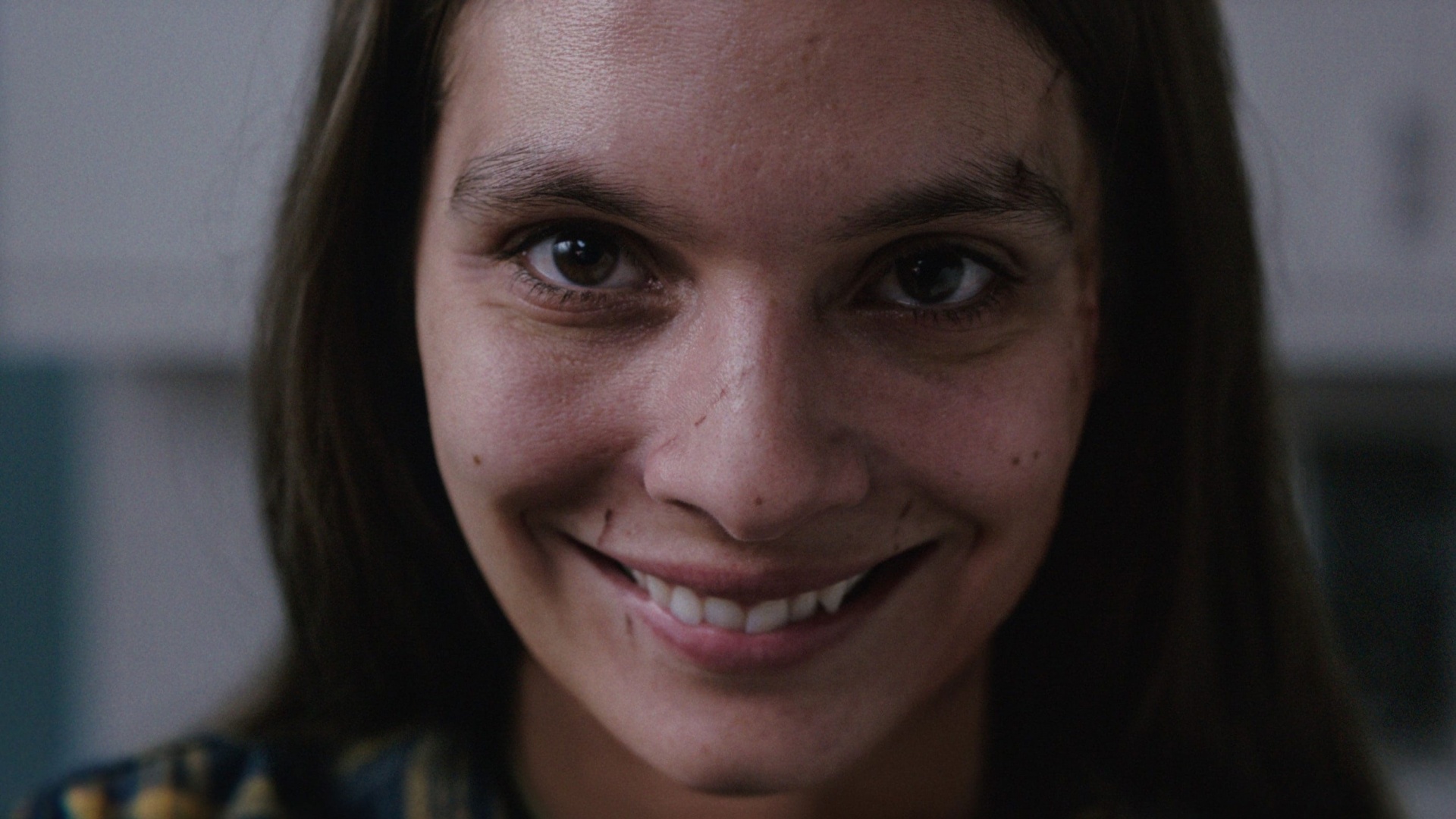
Smile (2022): As far as I can tell, this film got made because someone reached the end credits of It Follows and said "Great, now take it from the top, but a bit less good this time." Dr. Rose Cotter, a psychologist working in an emergency mental health unit, contracts a sort of contagious demon from one of her patients. The entity follows you around for a few days, appearing in the form of different people smiling the same creepy smile at you. Then it takes over your body and forces you to commit gruesome suicide in front of a witness, who then becomes the entity's next victim. The supposed irony of Rose's professional background - she treats crazy people, but now everyone thinks she's crazy! Cue Alanis! - is milked for all the heavy-handed messaging about mental health stigma it can possibly yield. There are a shitton of jumpscares. That's about it.

Here's a screencap of the creepy smile. If that image scares you in a way that you'd like to experience more of, then it's by no means a bad use of ~2hrs of your life! I had a pretty good time, to be honest, but it was all empty calories. It's probably not one I'm going to feel moved to rewatch.

Late Night with the Devil (2023): A 1970s late night talk show host, played by David Dastmalchian, gets more than he bargained for when he invites a possessed girl to appear on his Halloween special in the hopes of boosting his flagging ratings. This was good solid fun with great acting and some great campy scares. I wasn't 100% sold on the surreal twist in the final act, but that's more of a "this wasted its chance to end stronger" complaint rather than actively detracting from the film, if that makes sense. I liked it a lot! And I'd like to see more of Dastmalchian, I think. The only other role of his I've seen is when he played Gurathin in Murderbot, and since I hated the adaptation in general and his character specifically, I don't think that appearance did him justice. He acted the HELL out of this.

I'm also very interested to see more of Ingrid Torelli, who played the possessed girl. She's young and very early in her career so there's not exactly much backlog to delve into, but I found her extremely charismatic. And apparently she's Australian! We're such a horror powerhouse. Go us. :')

We Bury the Dead (2024): Speaking of Australian horror... The US accidentally deploys an experimental weapon off the coast of Tasmania, killing literally every single life form on the whole island. Daisy Ridley plays an American woman, Ava, whose husband was staying south of Hobart on a work retreat when it happened, and who has come to join the body retrieval effort to find him. On arrival Ava quickly learns that rumours of some of the dead coming back to life as zombies are true, and also that Hobart is still on fire and the army won't be letting anyone travel south until the flames are out. Unwilling to wait that long once she sees some of the zombies showing signs of what look like self-awareness, hoping desperately to find her husband resurrected and still himself, she and the wildcard fellow retrievalist she has bonded with give their unit the slip and set off alone for the husband's resort.

I watched this mainly for Daisy Ridley and did NOT expect to love it as much as I did. I spent the first few minutes uncharitably annoyed because Ava showed up in an Australia that has literally just lost, like, a full percentage of our population in a tragedy caused by her shithole fucking country (sorry US friends I love youse really) and immediately started trying to play the sympathy card about her bereavement to the visibly exhausted Australian soldier manning the registration desk, thinking she could get a super special exemption to go look for ONLY her husband and not be bothered to pitch in with the rest of the cleanup effort. (Australia is of course in no way the primary or intended victim of the American cultural tendency to view the whole rest of the world as a painted backdrop on which American stories, the stories that matter, play out - but we have taken enough collateral over the years that I have some bad feelings pent up, okay.) But I got past that quickly because 1) grief can make self-absorbed jerks of everyone, not just Americans and 2) her bullshit did actually get called out later in the film. Meanwhile, the meat of the story turned out to be that spoilers ) The zombies aren't really the source of much of the horror at all, and the ending left me so fucking happy, in a way that I would never have expected from a zombie flick.

I think We Bury the Dead and Midsommar are tied for my favourites in this post, and are probably up there with my favourites of this year's whole horror binge so far.
lucymonster: (bookcuppa)
I've built up enough of a backlog of media to post about that I'm breaking it down by theme to make the task less overwhelming. Today we have two books about Rome, starting with SPQR: A History of Ancient Rome by Mary Beard. This a solid, uncontroversial primer on Roman Republican and Imperial history, which balances sweeping overview with enough anecdotes and more intimate zoom-ins to keep things fun. Mary Beard takes a keen interest in the lives of ordinary Roman citizens as opposed to the elite few who dominate the written record; the challenge of finding sources life outside the elite literate sphere is self-explanatory, but Beard is very good at excavating narrative from the archaeological evidence (one of her other popular books, Pompeii, does this in even richer detail). She also offers good commonsense guidance on how to approach the written sources critically, especially those concerning the early monarchy, which loomed large in the later Roman memory but was so heavily exploited for political purposes (and the stories were so often blatantly fantastical - see the founding myth about abandoned twins being suckled by a wolf) that we have to see it as telling us more about the Roman Republic than about the pre-Republic period it claims to represent.

My main interest has always been in Augustus and the early Empire, and Beard's section on that felt sparse to me, though I can't tell whether it actually was sparse or whether I just know that material better than the other parts and so zipped through it faster. In either case, it's all fairly orthodox and nothing groundbreaking, but I'm probably never going to tire of hearing the tale of Augustus' career as Totally Not The Emperor! I'm A Regular Roman Guy! The First Citizen! An Upholder Of Republical Values And Restorer Of Ancient Customs! I Promise!!! retold, so. No real complaints.

Historical appetite whetted, I then read A Fatal Thing Happened on the Way to the Forum: Murder in Ancient Rome by Emma Southon. Until now I thought it was an immutable quality of books on Roman history that they would make me wistful for my undergrad days and my onetime dream of a career in academia. Not so! It turns out there are actually two kinds of books on Roman history: the ones that make me wistful, and the ones that make me think I would be quite happy if I never heard speak of another Roman for as long as I live, actually. It's not that any of the Roman social attitudes highlighted in this book were news to me. It's just that revisiting them all at once in such a concentrated way, with such minute focus on the grisliest details of the worst moral impulses gone as badly wrong as possible...well, it's a lot.

Because to be honest, and with no pretence at cultural relativity, the Romans did actually kind of fucking suck. Slaves were considered a type of livestock rather than a type of person. Women had some scraps of very provisional personhood, but violence against them was generally viewed as an exercise of legitimate power (if committed by a husband or father) or else as a crime of property damage against their husbands/fathers/families. Elite women were apt to be blamed for the death of any man who expired at home (never mind that Augustus was in his seventies and known to be in failing health; obviously he died because that evil SLUT Livia poisoned him!!!!!). Brutal public executions were all-ages entertainment. One guy organised a gladiatorial games in which, surviving accounts suggests, a condemned woman was raped to death by a bull in front of the audience. Another guy tried to have his slave fed to a tank of hungry sea lampreys for the crime of dropping a glass. (Please pause here to look up a picture of sea lampreys. Or, you know, don't.)

But setting aside all moral and marine revulsion, this is actually a very good and very entertaining book. Southon clearly knows her stuff, and behind the flippancy is some thoughtful scholarship on a) the way Roman values informed the use of violence at both state and individual levels, and b) the way those same values cloud the historical record through the underplayings, overplayings, baseless conjectures and straight-up falsehoods passed down to us by ancient sources.
lucymonster: (apologies good bitch)
This is...a really bad movie? Like, I knew going in that it was controversial and polarising, but I didn't expect it to be so badly made. Tonally it is straight-up incompetent: Gibson seems to want every moment that's drawn from the gospels to be equally weighty, meaning there are no lulls to make the crescendos stand out, so everything kind of just blurs into a sound-wall of emotional bombast. But then at the same time he seems more concerned about preserving the dignity of his characters than connecting us to their humanity, so we end up with all these ridiculously muted reaction scenes, like Mary watching her son get scourged half to death with only a single tasteful tear rolling down her cheek. Satan is depicted as a very pale twink with no eyebrows whose MO is to gently verbally discourage Jesus from going through with the sacrifice while menacingly stroking his pet snake. Judas gets mauled by a werewolf, I think? But then he's fine? (It happens very fast, in the dark, then cuts straight back to Jesus getting tormented. So IDK.)

I will grant that the violence itself is very brutal, and I guess if this was your first exposure to the gruesome historical realities of crucifixion, then the film might blow your socks off on those grounds alone. But the characters are so lifeless and the Satan stuff so cartoonish that I find it hard to take seriously even with my strong religious predisposition to do so.

On a more nitpicky note, I'm also annoyed by the Romans speaking Ecclesiastical instead of Classical Latin. Strictly speaking in that part of the empire at that time they should have been using Greek, but I can forgive the filmmakers preferring Latin for the sake of mainstream audiences; what I can't forgive is them not bothering to look up even the basics of classical pronunciation that any first year student from a half-competent classics department could have helped them with. I was SO ON BOARD for the idea of a script written entirely in ancient languages, but if you're going to make life so much harder for yourself in the first place, why the fuck would you not put in just that little bit of extra effort to do the thing properly? If that's how little thought or care Gibson put into his handling of the very accessible, widely studied Latin language then I shudder to think how bad his reconstructed Aramaic must be.

So, yeah. Unimpressed to say the least. I got about halfway through last night and will probably watch the rest tonight so as not to waste the $2.99 I spent on digital rental, but I did NOT expect to be this bored by the all-time most famously graphic film depiction of the central event of my faith.

Movie post

Jul. 9th, 2026 01:48 pm
lucymonster: (watchingthroughfingers)
Two new horror films have just opened up in local theatres, and I am debating whether to go and see them. (Saccharine will either be just what I want right now or will set my own body image issues spiraling; Evil Dead Burn is almost certainly too gory for me, but I'm fighting a reckless urge to ~test myself.) In the meantime, here's what I've been watching at home on a smaller screen:

Conclave (2024): The Pope dies; the Cardinals gather at the Vatican to elect a new one; much political intrigue occurs, and much anguishing of consciences. Ralph Fiennes carried this whole film as the convenor of the conclave, while Carlos Diehz supplied the pontifical eye candy as a badass (by ageing Catholic dude standards) newcomer who had been secretly appointed to the perilous archbishopric of Kabul after a career spent ministering in war and disaster zones. Very fun and tense and aesthetic. I do not have much else to say.

Black Death (2010): This entertainingly heavy-handed medieval action/horror stars Sean Bean as a Catholic warrior on a mission to catch a necromancer accused of using black magic to shield a whole village from the ravages of plague, and Eddie Redmayne as a novice from a nearby local monastery who volunteers to guide him to the village. It starts out as a gritty, filthy, dark historical adventure that takes the adventurers' faith very seriously, before eventually dissolving into an unintentional horror-comedy of Evil Pagans(TM) railing against the Church and trying to torture and trying to force the Christians to renounce God under threat of death and torture, while the Christians are all Vaderesque NOOOOOOOOOO, I'll never renounce God!!!!! Carice van Houten (the Evil Pagan(TM) queen) is so attractive it should be illegal. The twist end was...quite satisfying, actually! I can't take any of it too seriously but it was a very enjoyable watch.

Thesis (1996): Spanish horror/thriller about film student Ángela who, while exploring cinematic depictions of extreme violence for her thesis, stumbles across the existence of a snuff production ring operating in her university. Ángela is in deep denial about her fascination with death and gore and seems confused as to her own moral position; her impulse is to bury her head in the sand and forget all about the horrible criminal discovery. Her classmate Chema, an unabashed horror fan and collector of assorted video nasties, feels obliged to investigate. It is all very meta, and at times seems to be deliberately taunting the audience - many a time the camera will pan slowly towards a sight we are told is unspeakably grisly, only to dart away at the last possible second.

And some DNFs: I watched about half an hour of The Rite because I was in the mood for more films in the vein of The Exorcist, but it ended up being so much in the vein of The Exorcist (right down to the sad brown-haired young priest who boxes to work out and is the middle of a crisis of faith) that I was mostly bored by the time a heavily pregnant woman wandered on-screen and I realised I had recklessly forgotten to check if the movie had child death in it, so I paused and checked and...yeah, that's a nope. I started watching Send Help with high hopes, but the first few minutes were devoted to that guy from Teen Wolf being the most infuriatingly horrible business bro and my blood pressure couldn't take it. That is NOT the kind of stressed out I want to be while watching a horror movie! The Invisible Man was also the wrong kind of stressful, in a different way: Imagine you're dating Tony Stark, and he's a complete abusive psycho! (No thank you, I will not be imagining that.) Finally I watched a bit of The Cabin in the Woods, but the Whedonesque vibes just weren't what I was in the mood for - I may come back to this one at a later date, though, since it's such a classic.
lucymonster: (bookstack)
There is a story about a minister in Scotland in the eighteenth century who survived in his parish for ten years on a repertoire of four sermons. When some of his congregation asked whether they might have more variety he replied: ‘My friends, my sermons are intended to do you good. When I see that you practise what I have been preaching for so many years, then I will treat you to something different.’
~ Peter Cameron, Necessary Heresies

I’m sharing this quote mostly because it’s hilarious, but also because it makes a good point. I know I, at least, have an awful tendency to collect Christian teachings the way I collect books: greedily, with great self-satisfaction, at far too rapid a pace for me to ever put most of them to their intended use. How much more profitable it would be, and how much less fun, to really lock in and master what I’ve already received before reaching for the next theological ladder-rung!

With that said, here's some recent church-adjacent reading:

Three books under the cut )
lucymonster: (horror)
Leviticus (2026): Recently uprooted by his mother to a conservative Australian industrial town, Naim finds teen love with local boy Ryan. When he catches Ryan also hooking up with the pastor's son, Naim outs both other boys to their parents in retaliation, and the parents call in a faith healer to "cure" their sons of homosexual urges. But what the ritual actually does is summon a violent entity, visible only to the victim, that takes the appearance of whoever they're most attracted to and stalks them relentlessly with murderous intent.

This was both tragic and terrifying, though to be honest I'm still having trouble deciding whether Australian horror scares me so much more than other films because there's something objectively scarier about the films I'm choosing, or whether it just gets me more because the horror is happening to Normal People in Normal Places. (Non-Aussie friends, I'd be interested to compare notes!) Either way, this one joins the so far very short list of horror films that have required a genuine exertion of will for me to finish watching - not "flinch and cover my eyes" scary, but "flee the cinema and don't look back or else It's Going To Get Me" scary. Which is SUCH an endorphin rush once the fear finally wears off, lol. People online are understandably comparing Leviticus to the premise of It Follows, but I feel like they're doing fairly different things with the superficially similar premise: It Follows deconstructs the Sex Equals Death trope, while Leviticus gives Christian homophobia a literal demonic embodiment. The fact that the entity convincingly imitates your actual lover, instead of shifting forms arbitrarily, is a particularly sadistic twist. I walked out of the cinema unsure how much I actually liked the movie - it was so many emotions at once that "liking" feels almost beside the point - but the more I turn it over in my head, the more positive I feel.

I did have some quibbles with the way the exposition was done - certain supporting characters knew things about the entity that I wasn't convinced they should actually know given what they said about their own sources, and a couple of developments were skimmed over so quickly that I thought they were plotholes until I carefully combed over them again in retrospect. Those moments were a little immersion-breaking. But overall...yeah, I think this might have been pretty damn excellent, actually. I REALLY liked the sweeping shots of the town that showed off its desolation, and the industrial machinery sounds woven into the score. It was all very atmospheric and a very grounded, distinctive aesthetic.

Obsession (2026): Teenage boy Bear flippantly wishes for his crush to love him more than anyone in the world, on a magic object that turns out to actually work. Naturally, this turns into a horrific monkey's paw situation; Nikki's behaviour quickly turns possessive and unsettling, and then, when she feels their relationship under threat, truly frightening.

I am thoroughly on board with the great reception this film has been receiving. Partly because it's really fun, effective horror - Nikki's weird body movements, holy shit - and partly because I like the nuance in the underlying gender conversation. It feels like it's speaking to both sides of the post-#MeToo dating landscape: to the young women who are all too aware of the danger men pose in their lives (Nikki, helpless and humiliated and sexually exploited, is by the end shown pretty clearly as the primary victim), and also to the young men who are coming to understand their responsibilities a little better but still aren't fully ready to let go of all their gendered entitlement and also feel aggrieved by the sense that they're being cast as villains. On the surface Bear is also a pitiable victim of the wish, which he made without any expectation of it working and which in the end he proved willing to pay an extremely high price to redress. But in the middle there...hoo, boy. For a disturbingly long time after he realises the wish really worked, his hope is to alter rather than cancel it - to keep Nikki under his spell, but just to dial down the intensity of her magically induced obsession. The part that hit me most viscerally wasn't the gore, but the scene that cuts abruptly from Bear learning that pre-wish Nikki was confirmedly not attracted to him, to him forcefully fucking her while she moans in glassy-eyed ecstasy. It's just...ugh. Yuck.

And then again, as becomes increasingly clear as their relationship goes on, Bear does not actually have the choice to walk away from Nikki once the obsession has taken hold. Her behaviour towards him while under the influence of the wish is straight-up domestic abuse. It's such a mess. I love mess. This was great.
lucymonster: (lucy pevensie)
I've been thinking lately about modern vs traditional religious communication, and how prone we are to latching onto the the style and wording of our hymns/prayers/creeds/scriptural translations as somehow integral to the value of the message. Most recently it's reached me in the form of Anglicans wanking about the 1662 BCP vs the modernised Common Worship, but it happens everywhere from KJV purists to the elderly members of my own congregation who take serious offence over our minister referencing popular cinema in his sermons.

In one sense I get it, because I, too, like old things. The aesthetic, the mystique, the sense of continuity, the weight of long consensus and that little bit of extra effort they demand from modern audiences are all very attractive to me; also, a lot of modern Christian cultural products are just genuinely execrable. Non-Christian friends, you would not believe the things I have suffered while tuning into Christian radio! The IQ points I have haemorrhaged just from glancing at the fiction shelf of the local Christian bookshop! How much less embarrassing it is to withdraw into the venerable safety of organ hymns and thee/thou prayer language, and pretend that all the cringey stuff coming out of American megachurches and "hello fellow kids"-style youth ministry has nothing to do with me.

But on the other hand, in Christianity as much as in any other discipline, the writings and works of art we hold up as Culturally Important(TM) today were generally not created with posterity foremost in mind - they were created in the common language of their own day, in the culturally relevant forms of their time, usually (at least in the case of evangelically purposed materials) with the aim of reaching as wide an audience as possible. The gospels and epistles themselves were written in idiomatic Greek to reach an audience full of slaves, women, children, and assorted unwashed masses. So there's a very real sense in which works that strive to convey the Christian essentials in modern, widely accessible formats are truer to the spirit of those older works than the works themselves as preserved in amber today.

(There's also the deeper fact that Christianity is not actually supposed to be cool or glamorous or to confer social status on its adherents, but my understanding of that is still evolving and it also veers into much more theological territory than I'd like to discuss off-filter, so I'll just leave that there.)

All this is to say that I've been watching The Chosen, a TV series that dramatises Jesus' ministry and the lives of his first followers. I. AM. OBSESSED. It is actually good? Like, well-made and interesting? It is an enjoyable, entertaining work of art that stays true to the gospel narratives but fleshes them out into something that really resonates as human and relatable. I get to see Jesus Christ, the God of all creation made flesh, clowning around to amuse little children. Joking with His friends. Enjoying a simple meal. I get to see joy and disbelieving wonder on the faces of the people who experienced His miracles not as Sunday School lessons but as concrete, meaningful changes in their own personal lives. I get to see people being people, as surely in Roman-occupied first century Palestine as they are today. It's not VeggieTales for grownups, I swear to you guys. It is actual telly that actual people would actually, conceivably want to watch for pleasure and not just out of grim Christian duty. It is also an evangelically minded preaching of the gospel, but it's not only that, and it doesn't taste of medicine. It is blowing my tiny mind. I've never till now not had to work to make these stories feel real. Like, I know intellectually that they're true, but they feel so distant. This show brings them right up close in a way that feels...honestly, almost fannish. I'm not sure of the strict theological soundness of engaging with my religion as a fandom but, hey, black-or-white, thinking about Jesus has got to be better than not thinking about Jesus in any given moment, right?

The show also runs laps around the kind of storytelling that thinks it has to be ~twisty and ~shocking and ~unpredictable to keep people engaged. It's so much fun to start each episode knowing, oh, this is Mary Magdalene, she's going to get exorcised! Oh, this is the wedding at Cana, He'll be turning water into wine! and then spending the whole episode looking forward to the payoff with ever-mounting anticipation. I know all these stories. Everyone who's grown up in a culturally Christian community knows half these stories even if they've never in their life been to church. Stories that are actual good stories don't get boring just because you know the ending. If anything, I think knowing the broad outline of the plot can, in a well-handled production, free you to savour the nuances of the retelling, to notice the details, to draw out new messages from old. I know in fannish circles I'm 100% preaching to the choir on that one, but far too few TV showrunners are on the same page as us.

So, yeah. The Lord is my blorbo now, sorry guys. I'll try to keep it off main. At least I'm free from the burden of having to ship Him with everyone like I do with Kylo Ren.
lucymonster: (horror)
Backrooms (2026): I loved this!!! Admittedly, my reception has been coloured by the sheer delight of getting to go see it in theatre; I was able to book the perfect seat in an otherwise empty row, I treated myself to a big cup of mixed lollies in a fit of childlike exuberance, and all in all a great time was had while my husband generously managed the kids' bedtime alone. Under those circumstances the movie would have had to be very bad indeed before it would have dented my joy, but I do think it was genuinely good - especially for something made by a twenty-year-old youtuber.

Based on an internet creepypasta that I'd never heard of in my life but that is apparently hugely popular with Gen Z, Backrooms is about a struggling furniture store owner who passes through a wall in the back of his shop and finds himself in a liminal space of huge, labyrinthine office rooms that are just Not Quite Right: the architecture is all off-kilter, everything is faded yellow, and the space is completely empty aside from the scattering of random items in unlikely places throughout. His therapist gets roped into it as well, and two of his young employees. The ambience and sound design are key to the horror: not a lot of action happens, but the visual wrongness never lets up, and the awful noises made by the Mysterious Thing that stalks the backrooms had me clutching the armrests. If I get a second chance at an evening out then I am going to spend it on Obsession, but a part of me kind of wishes I could go back and see this one on the big screen again.

As Above, So Below (2014): My trip to see Backrooms was a second attempt at an evening out; the first one fell over, and As Above, So Below was my streamable-at-home consolation prize, plucked from a "You're obsessed with Backrooms, now what's next?" listicle. I can see their point, but the tone could hardly be more different and for me this one scratched a completely different itch. It's about a rogue archaeologist and her thrown-together team of urban explorers who blunder into a haunted hell dimension while searching the Paris catacombs for the Philosopher's Stone. It is ridiculous, corny, historically incompetent, and overall spooky as fuck. Someone clearly said, "Imagine if Indiana Jones was a beautiful twentysomething woman! And imagine if her tomb runs were even scarier and more deadly! No, don't worry about the plot, we're going for Vibes here, it doesn't have to withstand even three seconds of scrutiny! Also, I can get us approval to film in the actual real catacombs!" And then they took that as a mission statement and committed to it with their whole heart and soul. It was so dumb. I had such a good time.

The one misstep that I did actually take issue with was the choice to frame it as found footage. I get the vision, I do! But the script and the acting and the overall story are just way too campy to pass as subject matter for low-lit handcams. Absolutely no one is mistaking these people as real. They are actors reading lines. They are so, so obviously actors reading lines. They are having earnest dialogue about Nicholas fucking Flamel! The found footage conceit kept breaking my ability to immerse myself in the camp, and the camp kept breaking my ability to immerse myself in the found footage, and I think ultimately it would have been a much stronger movie if they'd just scrapped the handcams and accepted that nothing about the project was going to lend itself to realism. It should have been shot like the 80s-action/adventure-inspired brain candy it was.

Music post

Jun. 9th, 2026 08:09 am
lucymonster: (skeleton)
Apparently I have not posted about The Night Eternal since the start of 2025, which is insane, since in the whole intervening time they have been pretty much my favourite band after Iron Maiden. Their style - melodic, mournful heavy metal framed around themes of incredibly campy dark occultism - gets better the more I listen to it. In the last eighteen months I have played both albums to death and beyond, and now they have a new one slated to release in August!!! I'm so excited. Here is the first single they've just released, inspired - so the band say in their release statement - by Iron Maiden's Somewhere in Time:


And they're touring Europe with Messa! I am expiring from envy. I am sinking down into the netherworld to wallow in a pit of jealous, yearning darkness.


In other musical news, I've been getting back into classical lately. This is great because it gives me something to talk about with my dad, and also because there is SO MUCH glorious Christian music out there for which I'm now able to develop whole new nuances of appreciation. I've been aiming for variety, but I keep just wanting to relisten to Verdi's Requiem, which has got to be the most heavy metal piece of music in the world that contains not a single electric guitar. Go on. Listen to Dies Irae and tell me you do not feel moved to headbang even a little bit.

Other current favourites include Schönberg's Verklärte Nacht (so beautifully dark and dissonant!) and Chopin's Nocturnes. I've also been listening to the Brandenburg Concertos a whole bunch trying to force myself to Get(TM) Bach; I would not say I'm quite there with the Getting(TM) yet, but they are undeniably impressive.

A few nights ago I watched La bohème, the 1988 Pavarotti and Freni video recording. Growing up this was one of my sister's favourite operas (not mine - I was always more of a Mozart girlie) and it's so so funny to experience it again now and see the indelible imprint it has left on her fannish tastes. This woman LOVES herself a good pure, angelic woobie dying slowly and tragically of an incurable disease while the whole assembled cast look on and weep. Always has done, always will do. Meanwhile I am a heartless monster who was impatient for Mimi to just kick the bucket already. Musetta was so much more likable. I also very much enjoyed the scenes of the men clowning around, finding moments of joy in the midst of their desperate poverty. It's gritty, grounded storytelling by operatic standards. But I think next time I watch a full opera, I will go for something by Mozart.
lucymonster: (bookcuppa)
The Employees by Olga Ravn, trans. Martin Aitken: This Danish novella tells the story of a corporate space expedition gone wrong through a series of transcribed statements from employees aboard the ship. The statements are framed as having been given to a review team sent by the head office; no further context is supplied, except what can be pieced together from the statements themselves. The employees comprise natural born humans and lab-made cybernetic individuals called humanoids. Conditions are dire; both kinds of employee are effectively slaves, and devotion to the company has been deeply embedded in their psyches. Despite this, a rudimentary sort of rebellion is fomenting. The higher-ups have been rolling out a series of cheap, easily scalable technologies designed to paper over the catastrophic emotional wounds they are inflicting on their workforce, the latest of which are a mysterious set of objects from an alien planet that seem to exert some sort of lulling effect on people who get close to them. This ends about as well as anyone who doesn't sit on a board of directors could have told you from the start.

So basically, this story is a critique of late capitalist office culture. The message is not exactly subtle, but the trappings are so enthrallingly weird and creative that it ends up feeling like a lot more than the sum of its parts.

And Then There Were Nuns by Jane Christmas: This is a memoir by an established travel writer and devout Anglican who spends a year trying to become a nun. My first temptation is to scrutinise whether she really meant to be a nun or had just scented another marketable adventure, but I'm intentionally slapping that impulse away, because the book is lovely and deserves to be taken on its merits. And regardless of her initial purity of intention, the experience takes Christmas to some very heavy places. A session of lectio divina near the start of the process stirs up the memories of a rape she's spent decades of her life pretending never happened, so while discerning a possible vocation and grappling with her religious identity, she also ends up having to walk this painful path of trauma healing.

I also suspect that Christmas' obvious unsuitedness to cloistered life is exactly what makes the book work: she makes a good mediator between the kind of woman who is capable of becoming a nun, and the kind of woman (hi) who is not remotely capable of becoming a nun but could stand to profit from learning more about their ways. Christmas' fantasies of a life spent in an aesthetically pleasing state of leisurely communion with God are promptly supplanted by a hefty chore load, a jam-packed worship timetable, and the demand for a total renunciation of self-will. It’s not the big picture stuff she ends up chafing against. It’s the petty deprivations, like the dowdy habits (Christmas considers herself a fashionista) and the annoyance of not being allowed to finish her game when the hour of recreation ends. I get this. I think almost all of us probably get this, regardless of our vocation. I would give my life for my kids without a moment’s hesitation but will I give my morning coffee? Will I close my browser window, right this second, and go do something that benefits them instead? Because that’s what convent life is set up to train nuns to do. And watching an ordinary, self-willed woman fail at it is somehow very inspiring: I couldn’t do it either, not properly, but perhaps I could start doing a little bit more of it here and there! And perhaps that would be better than nothing!

At one point Christmas shared a remark from a priest, that taking confession from nuns is like being stoned to death with popcorn. I think that image will stick with me for a long time to come.
lucymonster: (horror)
A book as well as two more movies! I'm off my sickbed now and a bit movie'd out for the time being, so this will probably be the last of the deluge.

The Hollow Places by T. Kingfisher: Trying to get back on her feet after a divorce, thirtysomething Kara (nicknamed Carrot) goes to stay with her eccentric Uncle Earl and help him run his small-town museum of curiosities. She and her new friend Simon (a flamboyantly gay barista from the café next door) are repairing a hole in the museum's drywall when they discover a secret passageway on the other side of the hole that leads to a mysterious other world. At first, they think they've stumbled into a sort of Narnia. They very quickly learn that the truth is much darker.

I'm coming to think of Kingfisher as an author with a very strong brand; every book of hers I've read so far has featured some combination of relatable millennial protagonist (usually sorting herself out after the end of a bad relationship), lovable elderly mentor, casually queer supporting cast, quirky sense of humour, cute-but-has-attitude animal companion, and worldbuilding that straddles the line between horror, fantasy and fairytale. It's a lot of fun to read and has left me with a lovely cosy feeling despite the fairly extreme body horror scares along the way.

The Hitch-Hiker (1953): More thriller/noir than horror, but this seventy minutes of three men driving car through (as far as I can tell) the same stretch of American desert multiple times in a row was up there with many a lauded horror flick for how hard it made me sweat. Serial killer Emmett Myers poses as a hitch-hiker and forces two blokes on a fishing trip to drive him to a port city from which he plans to flee the country. There is something so satisfying about older movies that have not yet fallen prey to our exaggerated modern action/adventure norms: the fact that Myers has a gun he's willing to use is taken really fucking seriously. Nobody is badass-karate-disarming this guy. Not even when he’s asleep, in case he wakes up and shoots them. The lack of daring hand-to-hand combat does not make the film one iota less exciting.

The Shallows (2016): Blake Lively plays a surfer with no survival instincts, who hitch-hikes solo with a strange man in a foreign country whose language she barely speaks to get to a secret beach where no one knows to look for her. When this fails to get her killed, she goes out in the surf and stays there even after the local surfers who know the conditions have called it quits for the night and advised her to do the same. She sees a dead whale floating in the water and swims right up to it to investigate, and in doing so, royally pisses off the massive great white shark feeding on the carcass. She manages to get up onto a tiny rock island that is only above water at low tide, but the shark now sees her as a threat to its hunting ground (I have no idea how accurate this is in terms of shark psychology, though suspicion tells me Probably Not Very) and is so obsessed with killing her that it loses interest in the whale. This was very fun and very dumb and made me love not being a surfer even more than I already do. You will never, EVER catch me out there in water deep enough for sharks. Fun fact, this movie was shot in Australia! Motherfuckers are like, “Oh, Australia is so scary, all the snakes and spiders want to kill you!” and then they come here and go surfing. I have literally never even heard of anyone being harmed by a snake or spider. I personally know a guy who was bitten and almost killed by a shark.
lucymonster: (freddy)
(Yup, still sick and out of commission. Here are three more silver linings.)

Host (2020): As my horror binge has continued, I've already started to notice diminishing returns on the actual fear element - desensitisation, you know? But this one gave me a good hard scare. Set during the COVID pandemic, it's a little under an hour long and confined entirely to a Zoom call between a group of friends who have decided to conduct a virtual seance. The seance works. Aside from being scary as fuck, I really enjoyed how the film made use of the weirdness of life during lockdowns: new relationships forced to turn prematurely cohabitating, established friendships strained by distance, one of the characters reflexively stopping in the middle of a terrifying demonic manifestation to put on her mask before leaving the house. The storytelling is super lo-fi and pared-down, and I think it's a really good example of how a simple idea done cheaply and right can outperform many more lavish productions.

Halloween (1978): I have now watched the first instalments of all the "big three" teen slasher franchises, and this was by far my favourite. Michael Myers is an ontologically evil six-year-old who murders his teenage sister right after she's done having sex. Fifteen years later, he escapes from an insane asylum and goes back home to kill a bunch more teenagers before, during or immediately after sex. Jamie Lee Curtis is such a lovable Final Girl in this, and the music has to be up there with some of the most memorable movie theme songs of all time. I think I disagree very firmly with John Carpenter's conjecture that a pure, inhuman killing machine would be scarier than an actual character with actual motives, but I do admire the total lack of pretence to deeper meaning. Sometimes you want to watch "elevated" horror with Themes and Meaningful Stakes and shit; other times you just want to watch a monster in a mask cut people up for no reason.

White Zombie (1932): Did you guys know that zombies originate from Haitian folklore? Because I did not! In their original form, they are not plague-spreaders or brain-eaters but cheap, mindless labour in thrall to the sorcerers who raised them; early Western use of the lore seems to have revolved around zombies being forced to work on sugar plantations. In White Zombie, the first ever zombie movie, that is exactly what's happening. But one plantation owner takes the exploitation further when he enlists the help of sorcerer Bela Lugosi to zombify Madeleine, the newlywed woman he's obsessed with, and compel her into his romantic servitude. It is a gloriously silly story, shoddily produced by contemporary standards and almost comical by today's; I loved it anyway, not least for the maiden-in-trailing-gown-traipses-sadly-through-massive-gothic-castle vibes it delivered par excellence. And Bela Lugosi is, as always, brilliant. His smug, smirking expressions managed to be simultaneously hilarious and intimidating; I feel like even in intentional comedy-horror, those two emotions usually have to take turns? Good times.
lucymonster: (meesa back)
...that I found thought-provoking. Two hours long each, but very talky - I listened/semi-watched while doing other stuff, and I don't think I missed much that way.

If Pretty Is a Privilege, Ugly Is a Curse by Olurinatti: This is not, as I half-expected from the title, someone's personal plea to be less mean to unattractive people. It is actually a very thorough analysis of lookism as a form of structural inequality. It's SO uncomfortable to watch, because more than just about any other "category" of person I can think of, labelling someone as conventionally unattractive still feels like a malicious personal attack as opposed to an objective trait that materially affects their life. And yet, there is a very strong cultural consensus around beauty standards that operates independent of who a given individual does or doesn't find attractive, and these standards affect everything from employment opportunities to criminal justice outcomes. Our reluctance to discuss the issue in structural terms is really just one more example of lookism in action: we wholeheartedly embrace the premise that ugliness is an inherently bad thing, and a personal failing to be addressed on a personal level by some combination of grooming, lifestyle changes and beauty therapies. We can no more envision a movement of class solidarity among ugly people than among dishonest people, or selfish people, or people who are in any other way choosing to suck.

I'm not ready for this tier of activism, tbh. I'm too much in the thick of existential despair over the erosion of my own pretty privilege by ageing and weight gain. But hey, who knows, maybe the video has planted a seed?

The Rise and Fall of Misery Memoirs by Sarah Z: This video essay connects misery memoirs, the satanic panic, fraudulent holocaust survivor stories and the phenomenon of "celebrity" defectors from repressive regimes as different iterations of the same storytelling template within our hyperindividualist society: a vulnerable, childlike narrator recounts the unspeakable exotic horrors they have endured through a strictly personal lens, ending with an uplifting message about overcoming adversity through personal resilience. The audience enjoys a good, cathartic cry and a sense of virtue for having borne witness to the suffering. No further action is asked of them. No analysis of the structural failings that allowed that suffering to occur is admitted. Survivor stories that DO demand action or advocate for policy change, or that end with the survivor failing to perform the expected inspirational boostrap-pull, get shunted aside.

In my teens I remember voyeuristically devouring the "trauma" parts of popular mismems without much interest in the "uplifting" final act; I spent a good chunk of my twenties reading about the Holocaust and North Korea and various recent wars in the Middle East. So I've never had much interest in the bootstrappy stuff, but that's not a virtue so much as a mismatch between the bootstraps and my more cynical aesthetic tastes; I am absolutely guilty many times over of consuming real hardships as entertainment. Like Sarah Z, I'm left with no idea what to do about any of this, nor do I think that curiosity about the dark stuff in other people's lives is something it is necessarily either possible or desirable to excise from human nature. But it's something I think is worth reflecting on, especially when that natural human ghoulish streak collides with broader political trends in a way that discourages reform, rewards fraud, and silences the large majority of survivors whose complicated life stories do not fit into a neat narrative template.

Profile

lucymonster: (Default)
lucymonster

September 2026

S M T W T F S
  1234 5
6789101112
13141516171819
20212223242526
27282930   

Syndicate

RSS Atom

Style Credit

Expand Cut Tags

No cut tags
Page generated Sep. 8th, 2026 06:50 pm
Powered by Dreamwidth Studios